Ed Friedlander, M.D., Pathologist
scalpel_blade@yahoo.com

No texting or chat messages, please. Ordinary e-mails are welcome.

|

|
 |
 |
 |
 |
 This site complies with the HONcode standard for trustworthy health information: This site complies with the HONcode standard for trustworthy health information: verify here. |
This website collects no information. If you e-mail me, neither your e-mail address nor any other information will ever be passed on to any third party, unless required by law.
This page was last modified January 1, 2016.
I have no sponsors and do not host paid advertisements. All external links are provided freely to sites that I believe my visitors will find helpful.
Cyberfriends: The help you're looking for is probably here.
Welcome to Ed's Pathology Notes, placed here originally for the convenience of medical students at my school. You need to check the accuracy of any information, from any source, against other credible sources. I cannot diagnose or treat over the web, I cannot comment on the health care you have already received, and these notes cannot substitute for your own doctor's care. I am good at helping people find resources and answers. If you need me, send me an E-mail at scalpel_blade@yahoo.com Your confidentiality is completely respected. No texting or chat messages, please. Ordinary e-mails are welcome.
 I am active in HealthTap,
which provides free medical guidance from your cell phone.
There is also a fee site at
at www.afraidtoask.com.
I am active in HealthTap,
which provides free medical guidance from your cell phone.
There is also a fee site at
at www.afraidtoask.com.
 If you have a Second Life account, please visit my teammates and me at the Medical Examiner's office. |

|
 |
With one of four large boxes of "Pathguy" replies. |
 I'm still doing my best to answer
everybody.
Sometimes I get backlogged,
sometimes my E-mail crashes, and sometimes my
literature search software crashes. If you've not heard
from me in a week, post me again. I send my most
challenging questions to the medical student pathology
interest group, minus the name, but with your E-mail
where you can receive a reply.
I'm still doing my best to answer
everybody.
Sometimes I get backlogged,
sometimes my E-mail crashes, and sometimes my
literature search software crashes. If you've not heard
from me in a week, post me again. I send my most
challenging questions to the medical student pathology
interest group, minus the name, but with your E-mail
where you can receive a reply.
Numbers in {curly braces} are from the magnificent Slice of Life videodisk. No medical student should be without access to this wonderful resource.
 I am presently adding clickable links to
images in these notes. Let me know about good online
sources in addition to these:
I am presently adding clickable links to
images in these notes. Let me know about good online
sources in addition to these:
 My team:
pathology.org -- my cyberfriends, great for current news and browsing for the general public
EnjoyPath -- a great resource for everyone, from beginning medical students to pathologists with years of experience
Medmark Pathology -- massive listing of pathology sites
Estimating the Time of Death -- computer program right on a webpage
Pathology Field Guide -- recognizing anatomic lesions, no pictures
Freely have you received, freely give. -- Matthew 10:8. My site receives an enormous amount of traffic, and I'm still handling dozens of requests for information weekly, all as a public service.
Pathology's modern founder, Rudolf Virchow M.D., left a legacy of realism and social conscience for the discipline. I am a mainstream Christian, a man of science, and a proponent of common sense and common kindness. I am an outspoken enemy of all the make-believe and bunk that interfere with peoples' health, reasonable freedom, and happiness. I talk and write straight, and without apology.
Throughout these notes, I am speaking only for myself, and not for any employer, organization, or associate.
Special thanks to my friend and colleague, Charles Wheeler M.D., pathologist and former Kansas City mayor. Thanks also to the real Patch Adams M.D., who wrote me encouragement when we were both beginning our unusual medical careers.
If you're a private individual who's enjoyed this site, and want to say, "Thank you, Ed!", then what I'd like best is a contribution to the Episcopalian home for abandoned, neglected, and abused kids in Nevada:

My home page
More of my notes
My medical students
Especially if you're looking for information on a disease with a name that you know, here are a couple of great places for you to go right now and use Medline, which will allow you to find every relevant current scientific publication. You owe it to yourself to learn to use this invaluable internet resource. Not only will you find some information immediately, but you'll have references to journal articles that you can obtain by interlibrary loan, plus the names of the world's foremost experts and their institutions.
Alternative (complementary) medicine has made real progress since my generally-unfavorable 1983 review. If you are interested in complementary medicine, then I would urge you to visit my new Alternative Medicine page. If you are looking for something on complementary medicine, please go first to the American Association of Naturopathic Physicians. And for your enjoyment... here are some of my old pathology exams for medical school undergraduates.
I cannot examine every claim that my correspondents
share with me. Sometimes the independent thinkers
prove to be correct, and paradigms shift as a result.
You also know that extraordinary claims require
extraordinary evidence. When a discovery proves to
square with the observable world, scientists make
reputations by confirming it, and corporations
are soon making profits from it. When a
decades-old claim by a "persecuted genius"
finds no acceptance from mainstream science,
it probably failed some basic experimental tests designed
to eliminate self-deception. If you ask me about
something like this, I will simply invite you to
do some tests yourself, perhaps as a high-school
science project. Who knows? Perhaps
it'll be you who makes the next great discovery!
Our world is full of people who have found peace, fulfillment, and friendship
by suspending their own reasoning and
simply accepting a single authority that seems wise and good.
I've learned that they leave the movements when, and only when, they
discover they have been maliciously deceived.
In the meantime, nothing that I can say or do will
convince such people that I am a decent human being. I no longer
answer my crank mail.
This site is my hobby, and I do not accept donations, though I appreciate those who have offered to help.
During the eighteen years my site has been online, it's proved to be one of the most popular of all internet sites for undergraduate physician and allied-health education. It is so well-known that I'm not worried about borrowers. I never refuse requests from colleagues for permission to adapt or duplicate it for their own courses... and many do. So, fellow-teachers, help yourselves. Don't sell it for a profit, don't use it for a bad purpose, and at some time in your course, mention me as author and William Carey as my institution. Drop me a note about your successes. And special thanks to everyone who's helped and encouraged me, and especially the people at William Carey for making it still possible, and my teaching assistants over the years.
Whatever you're looking for on the web, I hope you find it, here or elsewhere. Health and friendship!




LEARNING OBJECTIVES
Give short accounts of these non-neoplastic conditions:
Give accounts of these proliferative, benign, and "low-grade malignant" neoplastic breast lesions, recognize obvious examples microscopically, and tell the significance to the patient:
Recognize easy examples of ductal carcinoma in situ, and distinguish the ones that are more likely to be aggressive. Recognize non-infiltrating lobular carcinoma. Recognize Paget's clinically and microscopically. Explain the significance of each.
Give an account of the risk factors, etiology, pathogenesis, clinical findings, gross and microscopic pathology, metastatic patterns, prognostic signs, and lab workup (including markers) for each of the common types of invasive breast cancer. Focus on the "why"'s when they are known. Mention distinctive features of breast cancer in the male.
Read a breast biopsy with reasonable accuracy.
Accurately deal with patient questions about supposed health hazards of breast implants. Give a short account of how pop claims arise and how physicians should evaluate them.
We have often seen in the breast a tumor exactly resembling the animal the crab. Just as the crab has legs on both sides of his body, so in this disease the veins extending out from the unnatural growth take the shape of a crab's legs. We have often cured this disease in its early stages, but after it has reached a large size no one has cured it without operation. In all operations we attempt to excise a pathological tumor in a circle in the region where it borders the healthy tissue.
-- Cornelius Celsus, ancient Roman physician.
 KCUMB Students
"Big Robbins" -- Breast
Lectures follow Textbook
QUIZBANK
Breast (all)
|
|
|
|
|
|
|
|
|
|
|
|
|
|
|
|
|
|
|
|
|
REVIEW OF ORIGIN, ANATOMY, PHYSIOLOGY

{47710} {47732} {47725}
The anatomy and the physiology of the breast should be familiar to you.
* One does not have to be a breast-feeding militant to take issue with Rubin & Farber's past statement that "The breast has become biologically superfluous in advanced societies."
The areolar tissue is pigmented, with smooth muscle and elastic fibers. There are a few apocrine glands here. Montgomery's areolar sebaceous glands (which prevent chapping) undergo hyperplasia during pregnancy; they are the little bumps. No one knows what "Toker cells" (clear cells in the epidermis of the nipple that can be mistaken for Paget's; Hum. Path. 39: 1295, 2008) really do.
The breast is composed of a system of branching ducts draining into 12-20 lactiferous ducts. The systems are extensively intertwined, and I would urge you to ignore talk about "separate lobes". Elastic fibers surround the lactiferous ducts and their branches. The lactiferous duct widens to become the lactiferous sinus underneath the nipple (some experts dispute whether this is actually a functioning entity; others say it helps hold milk).
Little groups of terminal ducts / acini are surrounded by a solid fibrous stroma. The stroma between these units is fibrofatty. As a woman gets older, there is usually more fat relative to stroma in the breast. This shows cancers (which are non-fatty) to advantage on mammography.
The duct system branches several times and ends in the "extralobular terminal ducts" ("collecting ducts", "interlobular ducts"). From each of these, a few "intralobular terminal ducts" ("intralobular ductules") branch into the centers of "terminal ductal lobular units" ("TDLU"'s, "acinar units"). These are tight clusters of tubes with a histology varies with the time of month.
* "Lobule" may refer to an individual TDLU or all the TDLU's supplied by one extralobular terminal duct.
During pregnancy, true secretory units (instead of just the little acini) sprout from each terminal duct, coming to dominate the breast histology. After delivery, milk production begins. You may see secretory units in a woman whose breasts have become tender during the first few cycles on the oral contraceptive pill, or "for no reason".
It's not clear to me that the male breast "is relatively insensitive to hormonal influences" (as Big Robbins once told us); men simply have little estrogen and less progesterone on board. Hence the breast tissue does not develop except under unusual circumstances.
Hormones to remember:
During pregnancy, estrogen and progesterone prevent the milk from being produced. When the pregnancy ends, lactation begins soon. Stimulation of the nipple causes production of both prolactin (which keeps lactation going) and oxytocin (which makes the milk come down).
At all levels of the duct-and-acinar system, there is a single layer of myoepithelium. You can stain it for smooth-muscle-actin or calponin or p63 or smooth-muscle myosin heavy-chain (we think the last two are your best choice today; don't use CK5/6 for myoepithelium in breast as there's a "basal-like cancer" that stains positive). This contracts in response to oxytocin to let the milk come down. During the second half of the monthly cycle, progesterone causes some proliferation of ducts and stroma in the lobules. When the cycle ends, these changes regress. After menopause, the lobules may vanish, leaving only the larger ducts.
Mother's hormones may produce some breast development in the newborn baby girl, and there may even be a bit of secretion ("witch's milk").
You remember that some breast parenchyma extends toward the axilla as the "tail of Spence". Generally, the upper outer quadrant of the breast is the most massive anyway, which probably explains why most breast diseases are most common here.
{20793} normal breast
{11769} normal breast, histology
{11770} normal breast, histology
{10748} pregnant lady's breast
 Pregnant lady's breast
WebPath Photo -- comments are down right now
You should remember the duct cells, lobules, and myoepithelial cells.
You remember the anatomic "milk line" (check on most non-human female mammals). Supernumerary nipples and supernumerary breasts (polythelia and polymastia) arise here, and are very common. Accessory breasts may or may not have nipples, but undergo the same changes during menstruation, pregnancy, lactation, and carcinogenesis as normal breast does.
DEVELOPMENTAL PROBLEMS
INVERTED NIPPLES are common, especially in larger breasts, and may make nursing more difficult. If a previously-normal nipple inverts, you have a problem, i.e., something has retracted underneath, and it's the stroma of a cancer until proven otherwise.
JUVENILE HYPERTROPHY ("virginal hypertrophy"): very large breast(s) developing around puberty. Really hyperplasia, of course. The etiology is unknown, and occurrence is usually sporadic, though a familial syndrome is reported (J. Adol. Health 35: 151, 2004). (Nowell's law at work, probably.)
{49360} giant fibroadenoma in a teen
HYPOMASTIA: almost complete failure of breast development. (* Around half of these women have mitral-valve prolapse. See NEJM 309: 1230, 1984.)
By contrast, very large breasts are likely to cause serious low-back problems.
{49359} hypoplasia of breast
INFLAMMATIONS: Not common.
ACUTE MASTITIS and BREAST ABSCESS: Usually occurs during early lactation. (In a non-lactating
woman, the usual problem is a pre-existing dermatitis, smoking, and/or
a piercing -- J. Am. Coll. Surg. 211: 41, 2010).
The bug is usually staph aureus (abscess-maker). More than half of the staph cultured from breast
abscesses are now methicillin-resistant staph
(Arch. Surg. 142: 881, 2007). Less often it's a
streptococcus
(spreading cellulitis). The surgeon may need to drain it; it is almost never a sign of cancer (Am. J. Surg. 192: 869, 2006).
(abscess-maker). More than half of the staph cultured from breast
abscesses are now methicillin-resistant staph
(Arch. Surg. 142: 881, 2007). Less often it's a
streptococcus
(spreading cellulitis). The surgeon may need to drain it; it is almost never a sign of cancer (Am. J. Surg. 192: 869, 2006).
FAT NECROSIS: A solid mass, often in a fat breast, caused by a blow or other injury. Necrotic fat cells surrounded by a mixed inflammatory infiltrate, later with calcification, foreign body reaction, scarring. Before there was much notice paid to domestic violence, the etiology was "mysterious".
PERIDUCTAL MASTITIS ("recurrent subareolar abscess"): A hyperkeratinizing squamous metaplasia going too far down a lactiferous duct. This gets inflamed and needs to be cleaned up by a surgeon. Almost all these people are smokers, and both men and women are affected.
DUCT ECTASIA: An uncommon cause of a breast mass, usually in older women, usually tender and with nipple retraction. Chronic inflammation and fibrosis around ducts are typical. The ducts are loaded with a lipid-and-macrophage rich material. The cause is unknown; an old reported link to prolactinoma has not held up.
* "Plasma cell mastitis", an old diagnosis, is probably just duct ectasia with a lot of plasma cells.
* LYMPHOCYTIC MASTOPATHY is evidently an autoimmune disease. It runs with Hashimoto's thyroiditis and type I diabetes ("diabetaic mastopathy"). There is a dense lymphocytic infiltrate around some of the lobules, perhaps with fibrosis; a proliferation of epithelium and stroma may simulate cancer. These lesions are patchy but may produce masses.
* GESTATIONAL GIGANTOMASTIA is a thankfully rare, severely-crippling disease in which a pregnant woman's breasts become enormous, become ulcerated, get infected, etc., etc. It resolves after delivery and recurs with subsequent prenancies. Review and algorithms: J. Plast. Recon. Surg. 118: 840, 2006.
* Probably the rarest breast disease with a name is INFLAMMATORY GIGANTOMASTIA, featuring enormous overgrowth of the breast stroma and atrophy of the lobules, with lymphocytes around the ducts and anti-nuclear antibodies (J. Clin. Endo. Metab. 90: 5287, 2005; disturbing images).
* GRANULOMATOUS LOBULAR MASTITIS (Pathology 36: 254, 2004; J. Am. Coll. Surg. 206: 269, 2008) is confined to the breast lobules. All these women have been pregnant. Probably there is some autoimmune reaction against the secretory units.
, sarcoidosis, and reaction to a ruptured
implant.
GALACTOCELE: One or more ducts became plugged during lactation.
MONDOR'S DISEASE is uncomfortable thrombosis of one or more subcutaneous veins of the breast, a minor mystery that is usually harmless (NEJM 352: 1024, 2004). Check for an underlying cancer.
RUPTURE OF AN IMPLANT is commonplace, and in fact the fibrous capsules that ordinarily form around implants help contain this. How radiologists tell whether the implant has ruptured: Plast. Rec. Surg. 120: 495, 2007.
{49350} lipogranuloma from ruptured polyethylene breast implant
|
|
|
|
"FIBROCYSTIC CHANGE OF THE BREAST" (don't call it mammary dysplasia, chronic cystic mastitis, etc.)
This is the commonest "disease" of breast. Probably most women have some of these histologic changes as some point during their reproductive lives.
It presents as a lump or lumps. Actually, it is always multifocal.
The cause, of course, is obscure. Unopposed estrogen is a known factor, and in the 1970's we noticed that women on the estrogen-progesterone balanced pills get less fibrocystic change.
Despite much "pop" / "medical" wisdom, there's not much to suggest that modifying a lady's diet will help her fibrocystic changes: J. Am. Diet. Assoc. 100: 1368, 2000.
* Toremifene (the estrogen receptor modulator that blocks estrogen effects) for premenstrual mastalgia: BJOG 113: 713, 2006.
Three patterns occur separately or together:
1. (stromal) fibrosis
2. cyst formation (>3 mm)
3. adenosis
(STROMAL) FIBROSIS: dense collagenization distorting and compressing the epithelial structures.
This is most common in upper outer quadrants, patients in 30's.
* Your lecturer cannot agree with "Big Robbins's" old claim that the fibrosis results from ruptured cysts. If the cysts were filled with water, there would be no reaction. If the cysts were filled with something else, there would be a macrophage reaction, which you don't see in "breast fibrosis". It's very common for this to be picked up as suspicious for cancer on mammography, and even the fanciest modern MRI's cannot distinguish it from cancer (AJR 197: 755, 2011).
CYSTS: dilated ducts containing cloudy serous fluid (sometimes bloody or infected)
All breasts during childbearing years contain microscopic cysts. They are abnormal when they got larger than 2 mm or so.
Grossly, the blue-dome cyst is very familiar. Epithelium may be flattened, cuboidal, columnar, piled up, and/or show apocrine metaplasia. Surrounding stroma likely to be fibrous. Cysts likely to be tender before menses and after drinking coffee.
ADENOSIS:
{21062} fibrocystic changes, breast
{25567} fibrosis of breast
{25568} fibrosis of breast
{25569} cystic change of breast
|
|
|
|
|
|
|
|
|
|
PROLIFERATIVE BREAST DISEASE (review NEJM 353: 229, 2005)
2. Sclerosing adenosis
3. Small duct papillomas
EPITHELIAL HYPERPLASIA means more than the usual two layers of cells in ducts and/or lobules. At least one layer will be myoepithelial cells.
Cells are piled up and may even fill ducts and/or ductules. Between the heaps of cells, you will see cracks and crevices, and at least the bottom layer will be myoepithelium. Most often, there is a mixed population of cells.
If it looks quite benign, it's called "usual ductal hyperplasia". Its presence gives maybe double the lifetime risk for a breast cancer.
If there are some architectural features suggesting progression toward malignancy (swiss cheese, myoepithelium only on the bottom layer) you may diagnose ATYPICAL DUCTAL HYPERPLASIA, depending on location. The cells do not fill the ducts or acini, as cells of an official "in-situ cancer" would. (Atypical ductal hyperplasia commonly lacks 16q.) If parts of lobules are partially filled with abnormal cells, you may diagnose ATYPICAL LOBULAR HYPERPLASIA.
If there's a little anaplasia, this may also push the pathologist toward "atypical hyperplasia."
Don't try to figure out exactly where to draw the line between "atypical hyperplasia" and "carcinoma-in-situ", because the line is obviously a cultural construct with little-or-no biological meaning. "Low-grade CIS" is only slightly more likely to progress to invasive cancer and death than is "atypical hyperplasia."
* Pathologists are now using the "ADH-5 cocktail" of immunostains. Cytokeratins 5, 14, 7, and 18, and p63 are used to light up the slide. CK5, CK14, and p63 stain the basal cells / myoepithelium green, and CK7 and CK18 stain the other epithelial cells red. Even with this marvel, agreement among pathologists is only so-so... in one big series, 7 or more out of 9 pathologists agreed 47% of the time (Mod. Path. 24: 917, 2011). In an eye-opening popular article, community pathologists matched the consensus diagnosis only about 75% of the time on plain H&E sections (JAMA 313: 1122, 2015 -- the ones that were problems tended to be ones for which the community pathologists said they'd get consultation, and special stains weren't allowed.)
Since "atypical ductal hyperplasia" gives a woman at least five times her baseline chance of getting breast cancer, and since maybe one woman in nine who lives to old age will get breast cancer eventually, you'll want to follow these women closely.
FLAT EPITHELIAL ATYPIA, only recently characterized and about as premalignant as atypical epithelial hyperplasia and considered the first precursor for hormone-dependent bresat cancer, consists of a stratified epithelium with architectural atypia (scrambled cells) and some cellular atypia, sometimes recalling dysplasia in the cervix (Hum. Path. 38: 35, 2007; Arch. Path. Lab. Med. 132: 615, 2008; Am. J. Surg. 201: 245, 2011), or else just a very thin layer of clearly malignant cells ("clinging cancer"). Imaging is useless in making the call (AJR 197: 740, 2011). Often there's nearby atypical hyperplasia or worse (Am. J. Surg. Path. 36: 1247, 2012), and if this is found, say, on a needle biopsy, wider excision is in order (confirmed J. Clin. Path. 64: 1001, 2011). Review of "flat ductal intraepithelial neoplasia" of the breast: Arch. Path. Lab. Med. 133: 879, 2009.
* No one knows quite what to make of "columnar cell change", in which the cells become tall and skinny, often in the setting of some other hyperplasia. This has been reviewed and beyond it being a sign of genetic instability, there's little else to conclude -- simply look for the presence of atypical hyperplasia elsewhere in the same biopsy (Am. J. Surg. Path. 29: 734, 2005; Cancer 113: 2415, 2008).
SCLEROSING ADENOSIS: proliferation of small ductules and sometimes even acini in a fibrous stroma.
This mimics cancer both clinically and microscopically. Usually it's a tender lump in the upper outer quadrant. Patients are usually around age 30-40.
Sclerosis adenosis isn't cancer, and probably doesn't turn into cancer, but its presence means an increased risk for future breast cancer.
Tipoffs that you are looking at sclerosing adenosis rather than cancer:
(1) There'll always be myoepithelium, for which you can stain (smooth-muscle actin, S100, high MW keratin).
(2) The normal lobular architecture is preserved, though lobules may be expanded. This is a low-magnification diagnosis.
(3) Sclerosing adenosis can be hard, but it never cuts "gritty" like many breast cancers.
{25570} sclerosing adenosis
* One particularly treacherous sclerosing adenosis variant is "microglandular adenosis", round uniform glands everywhere, even in the fat, no myoepithelium, but with no anaplasia and no desmoplasia. Thankfully, this hated pseudocancer stains positive with S100, and does not show the angulated glands that we see in cancer. It seems to be premalignant, though most excisions are curative. (Arch. Path. Lab. Med. 131: 1397, 2007).
SMALL DUCT PAPILLOMAS seldom produce masses. These possess fibrovascular cores, with epithelial hyperplasia-type lesions on the top; myoepithelial cells (* recognizable by their staining properties of course) within the lesion demonstrate it is a papilloma rather than carcinoma in situ. Leave the diagnosis of actual malignancy in such lesions to us.
All of these have a multiplicative risk with familial history of breast cancer, i.e., these benign lesions are probably caused by mutations of genes other than BRCA1, BRCA2, and p53.
RADIAL SCAR is a star-shaped fibrosing lesion that looks like a typical crablike cancer on mammography but that proves utterly benign on excisional biopsy and confers no increased cancer risk. A larger version is called COMPLEX SCLEROSING LESION. See Am. J. Surg. 180: 428, 2000.
 Radial scar of breast
AFIP. Quite benign.
Wikimedia Commons
* Don't worry about the baffling "collagenous spherulosis" or a host of other benign lesions.
FIBROADENOMA (pathology: Am. J. Clin. Path. 115: 736, 2001)
The most common benign breast tumor, occurs at any time during reproductive life, most often under age 30.
It presents a small, sharply circumscribed, usually single, freely movable nodule within the breast substance.
A loose stroma surrounds ducts that are often crushed flat.
* Ignore the old distinction between pericanalicular and intracanalicular fibroadenomas.
Fibroadenomas are not cancer and do not turn into cancer, but having had a fibroadenoma maybe triples a woman's future cancer risk.
{08461} fibroadenoma, gross
{08942} fibroadenoma, histology
{08943} fibroadenoma, histology
{08944} fibroadenoma, histology
|
|
|
|
* "Lactating adenoma" is a focus of lobular hyperplasia in the breast of a pregnant or lactating woman. The glands are filled with secretory product. Leave the diagnosis to us.
PHYLLODES TUMOR: a bad term for a "worrisome fibroadenoma" that exhibits two epithelial cell layers along with a dense, metaplastic and/or anaplastic stroma, a clefted (artichoke-like) gross appearance, and supposedly rapid growth. The old name was "cystosarcoma phyllodes" (especially unfortunate since cysts are rare).
If it metastasizes, it will usually be as a sarcoma. But most patients do not develop metastases.
Pathologists are now reporting these as "benign" or "malignant" (the latter can metastasize as the corresponding sarcoma). However, predicting behavior based on histopathology isn't very reliable, and adding molecular markers (c-kit, p53, Ki-67) doesn't really help either (nice review though, Arch. Path. Lab. Med. 130: 1516, 2006). Update Arch. Path. Lab. Med. 131: 1568, 2007; J. Clin. Path. 66: 496, 2013 (neither morphology nor genetic studies help much with prognostication). A prognosticating system relying on atypia, mitotic figures, and surgical margins: J. Clin. Path. 65: 69, 2012.
"Phyllodes" means "leaves", referring to the artichoke-like gross appearance of many of these tumors.
It's interesting to speculate about how both epithelium and stroma overgrow in a fibroadenoma or a phyllodes tumor. Since stromal mitoses are much more common adjacent to epithelium, the epithelial cells are probably producing a factor that causes stromal overgrowth. In fully malignant phyllodes tumor, the stroma becomes an autonomous sarcoma (Nowell's law again). See Cancer 70: 2115, 1992; clinical review Cancer 77: 910, 1996.
 Phyllodes tumor
WebPath Photo -- comments are down right now
* PSEUDOANGIOMATOUS STROMAL HYPERPLASIA is a newly-recognized mimic grossly and microscopically for fibroadenoma. It may present as one or more nodules. It looks like tiny vessels ("uh-oh, an angiosarcoma") but the cells are actually myofibroblasts, not endothelium. No pathologist would mistake it for cancer. It's "pseudoangiomatous" because myofibroblasts line little cracks in the fibrous tissue; they are positive for the progesterone receptor for some reason. Extensive disease can be symptomatic. See Arch. Path. Lab. Med. 134: 1070, 2010.
LARGE DUCT PAPILLOMA
This is a little (less than 1 cm) lesion in a major duct just below the nipple.
It produces bloody nipple discharge when bits twist and break off. Occasionally it causes nipple retraction.
{20230} intraductal papilloma
 Papilloma
WebPath Photo -- comments are down right now
One in 100 of these tumors is actually a papillary carcinoma. (This is a hard call. Do not expect your pathologist to call these tumors benign or malignant on frozen section.) All about papillary lesions of the breast: Arch. Path. Lab. Med. 133: 893, 2009.
Future radiologists: Visualize them using a galactogram, injecting dye into each of the lactiferous sinuses (Am. J. Roent. 159: 487, 1992.)
INTRODUCING CARCINOMA OF THE BREAST ("breast cancer").
|
|
|
|
|
|
Breast Cancer Australian Pathology Museum High-tech gross photos
|
Breast cancer
Ed Uthman
Wikimedia Commons
{00120} breast carcinoma, gross, skin dimpling
{00126} breast carcinoma, gross, recurrent at mastectomy site
{07561} breast carcinoma, gross
{10924} breast carcinoma, gross
{10928} breast carcinoma, gross
{12441} breast carcinoma, gross
{12533} breast carcinoma, infiltrating, gross
{49362} breast carcinoma
{49352} breast carcinoma
{24600} breast carcinoma
{10749} breast carcinoma
{00123} breast carcinoma, cytology
This is the commonest cancer in women (though no longer the #1 cancer killer), and still "the most feared cancer" -- justifiably so!
There were around 234,580 new cases of breast cancer in 2013 in the U.S. (up from 180,000 in 2007 because of more aggressive searching), and 40,030 deaths (down from 41,000 in a somewhat smaller populat in 2007 becase of more aggressive searching). Of these, 2240 new cases will be in men, and 410 of these men will die of it (little change recently).
It is rare before age 25, and of course more common with increasing age.
Around 1 in 9 women will develop breast cancer during her life.
Breast cancer usually presents as a dominant, painless mass. Nowadays it is often found on mammography long before symptoms appear. Remember that 10% of breast cancers do not show up on mammography.
"Risk factors" (big review Lancet 346: 883, 1995):
Every ethnic group has a high incidence of breast cancer; American Indians have the least.
* A history of bilateral cancers and/or onset in a young women suggests a familial tendency.
Early-onset familial breast cancer is usually due to germline mutations of BRCA1 or BRCA2, less often Cowden's, e-cadherin (CDH1, see below), Fanconi (FANC), CHEK2 (the supposed "Li-Fraumeni 2"), ataxia-telangiectasia (ATM), Peutz-Jeghers, Li-Fraumeni (TP53), or PALB2 (long-overlooked; NEJM 371: 497, 2014).
Of these, only BRCA1, BRCA2, and TP53 give a tremendous risk (10- to 20-fold.) The rest are statistical associations ("less than twofold" to "two-to-fourfold").
Not surprisingly, BRCA1 tends to be lost in sporadic breast cancers, though not by mutation (Nat. Genet. 21: 236, 1999); * "Big Robbins" merely notes that BRCA1 mutations are uncommon in sporadic breast cancer.
You can't spot hereditary breast cancer syndromes by morphology. It's generally known that BRCA1-deficient women tend to have cancers with big cells, high mitotic rates, pushing borders, and lots of lymphocytes; the morphology is often "medullary" by classic histopathology OR the immunophenotype is "basal-like" (J. Clin. Path. 61: 1073, 2008; Arch. Path. Lab. Med. 134: 130, 2010 -- "green stuff on ADH-5"). Claims that certain subtypes suggest BRCA2 deficiency haven't held up well.
* An attempt by insurers to deny benefits to breast cancer victims with germline BRCA1 mutations "because it was a pre-existing condition" (Science 272: 1094, 1996) led to Uncle Sam making it illegal for insurance companies to consider genetic predisposition a "pre-existing condition" and denying coverage (thanks Bill). The really good genetic non-discrimination bill was passed only in 2008 (bipartisanship).
* Women are now coming in for prophylactic bilateral mastectomies because they have the genes and/or a strong family history. This cuts the risk by at least 90% -- but not entirely, since the breast is not a sharply-circumscribed organ (NEJM 340: 77, 1999). These resected breasts are usually normal on pathologic study: Arch. Path. Lab. Med. 124: 378, 2000. A woman who chooses this option at age 30 adds 3-5 years to her life expectancy (NEJM 336: 1465, 1997); what's more, patients seem to be very happy about this (JAMA 284: 319, 2000). The Swedish experience Ann. Surg. 253: 1147, 2011.
* As noted, ataxia-telangiectasia carriers may be at extra risk; this continues to be discussed (Mayo Clin. Proc. 72: 54, 1997). A non-disease allele here is known to be more common in breast cancer patients than in controls (Cancer 100: 1345, 2004).
The "balanced" estrogen-progesterone pill for post-menopausal women seems to increase the risk even more: JAMA 283: 534, 2000.
Estrogen replacement as a risk factor for breast cancer after menopause remains controversial. Most past studies have indicated no link (Cancer 95: 960, 2002 found a link for Hispanic women). Especially see JAMA 268: 1900, 1992. The latter authors decided that probably women who get estrogen replacement go to the doctor more and get early detection of their breast cancers. Even the article that caused the hoopla over estrogen replacement (JAMA 288: 872, 2002) didn't show a believable link.
* Watch for raloxifene ("Evista"), a medicine that was initially reported as working as an estrogen on bone, and an anti-estrogen on breast, as a handy drug for post-menopausal women (JAMA 28: 2189, 1999). Since its introduction almost a decade ago, it does seem to help slow osteoporosis and diminish the risk for breast cancer, but at the price of increased risk of venous thromboembolism and fatal stroke (NEJM 355: 125, 2006; J. Clin. Endo. Metab. 91: 3941, 2006).
* The conventional wisdom that estrogen replacement is absolutely contra-indicated in women who have had breast cancer is now being reconsidered: Geriatrics 57: 25, 2002; Am. J. Ob. Gyn. 187: 289, 2002.
* The "melatonin hypothesis" linked low melatonin levels to breast cancer; the evidence includes claims that nurses who work night shifts have greater risk, and that blind women have only half the rate of breast cancer. Normal breast epithelial cells are loaded with melatonin receptors (Am. J. Clin. Path. 118: 451, 2002). I predicted in 2002 that "the melatonin hypothesis" was based on recall bias and would soon be discredited, and now one major study found no relationship (JNCI 96: 475, 2004).
NOT risk factors...
* The pop claim that antiperspirants cause breast cancer is simply a lie.
The oral contraceptive pill is not a risk factor (at least I'm satisfied; NEJM 346: 2025, 2002 supports much previous work). Nor is intrauterine DES exposure (Cancer 107: 2212, 2006).
There is still talk of high-fat, low-fiber diet being a risk factor; I saw the earlier studies and was totally unimpressed. In a study in which the researchers controlled for other risk factors, all correlation between diet and breast cancer vanished (JAMA 268: 2037, 1992); another big negative study: JAMA 281: 914, 1999, more recently Am. J. Med. 113(S9B): 63S, 2002. Cancer 109(12 S): 2712, 2007 summerized past studies supposedly showing some effect and concluded they were all lousy and that the only demonstrated risk was weight-gain and alcohol abuse. A mega-review of diet and breast cancer risk turned up essentially nothing interesting (Am. J. Clin. Nutr. 91: 1294, 2010).
| Despite a total lack of empirical evidence or a scientific basis to believe one might get a positive result, a massive controlled study of a diet very high in fruits and vegetables and fiber and low in fat was undertaken in women with newly-diagnosed breast cancer ("the Women's Healthy Eating and Living randomized trial.") It was a stunning failure -- no impact on cancer outcome, new cancers, or overall health or mortality (JAMA 298: 289, 2007). Obviously the study was driven by pop claims; sadly, the failure received no media attention. Follow-up Cancer 117: 3805, 2011. |  Uh, sorry....! (Even their website's down now.) |
In a review of Adventist diet studies (they eat little or no meat), the folks at Harvard, not noted for political incorrectness, pointed out that Adventist women have at least as high a rate of breast cancer (and men of prostate cancer) as meat-eaters. The authors even cite (in my opinion weak) studies in which vegetarianism seemed to be a risk for breast cancer. The authors seemed to consider the claimed link between fat consumption and breast cancer to be fully discredited by the time the paper was written. Am. J. Clin. Nutr. 78(S3): 539-S, 2003.
* Pregnancy after treatment for breast cancer does not increase the risk of a bad outcome (Lancet 350: 319, 1997).
* Residental magnetic fields (Am. J. Epidem. 155: 446, 2002) -- let's get real.
* Some anti-abortion activists claim that having an abortion will increase the woman's later risk of getting breast cancer. The White House at one time got concerned (Nat. Med. 10: 759, 2004), but nevertheless it is probably not true. Now is as good a time as any to bring up "statistical relationships" and the problems they cause. For starters, there seems to be a massive reporting bias (i.e., women with breast cancer confess to having had an abortion, healthy women deny it: Am. J. Epidem. 134: 1003, 1991). The Swedes keep records rather than relying on patient reports, and when these were checked the effect disappeared (Br. Med. J. 299: 1430, 1989). A study from New York based only on examination of reports of fetal deaths and breast cancer cases found a positive correlation; but they did not take into account whether and when the women had term pregnancies. See also Int. J. Cancer 48: 816, 1991. JAMA 275: 283, 1996 & 276: 31, 1996 indicated that there's small, if any, increased risk from an elective abortion. NEJM 336: 81, 1997 found no overall risk. Nor did Am. J. Pub. Health 89: 1244, 1999. Neither did Br. J. Cancer 79: 1923, 1999. Neither did Science 299: 1498, 2003. Neither did Lancet 363: 1007, 2004 (I think this one should have closed the book). Neither did the Scotch study (J. Epid. Comm. Health 59: 293, 2005). A slight, probably bogus, protective effect from having had an abortion: Int. J. Cancer 110: 443, 2004 (Boston). No effect in African-Americans: Cancer Caus. Contr. 15: 104, 2004. No effect from either spontaneous or induced abortion: Arch. Int. Med. 167: 814, 2007 (prospective cohort study). The American College of Obstetrics and Gynecology is on record that there is no connection (Ob. Gyn. 113: 1417, 2009). A fair amount of litigation resulted from the alleged link, and maybe you should mention this "controversy" in "informed consent" if you are going to do abortions. In 2012, a bill was introduced into the Kansas legislature requiring all physicians to tell women that abortion causes breast cancer. And so it goes.
* In the early 1990's, Greenpeace launched a massive campaign, directed at the public, claiming that organic chlorine compounds in industrial pollution are the great cause of breast cancer today. Supposedly these are estrogens and also cause increased oxidative damage to DNA; however women with breast cancer don't have any more of oxidative damage to DNA, or organochloride compounds on board, than do controls (Arch. Env. Contam. Tox. 41: 386, 2001; Env. Health Perspect. 109 (S1): 35, 2001, even CA 52: 301, 2002 called it an obvious lie). Greenpeace's inflammatory rhetoric was typical of junk-science-based disinformation campaigns ("Paradigm shift!" "Scientific-medical establishment!"). To their credit, Greenpeace has abandoned this false claim.
The left breast is involved a few % more cases than the right. That's probably because the left breast is a few % bigger.
There are a host of tumor types that we'll cover now.
NONINVASIVE ("IN SITU") CARCINOMA
DUCTAL CARCINOMA IN SITU ("DCIS")
Of course, to confirm that the cancer is non-invasive, the savvy pathologist can stain the myoepithelial cells. Smooth-muscle myosin heavy chain is most popular today (SMMHC J. Clin. Path. 57: 625, 2004).
The College of American Pathologists recommends this system for grading ductal carcinoma in situ:
2. In-between
3. Most nuclei are more than 2.5 red cell diameters, with coarse chromatin and prominent and/or multiple nucleoli.
* For historical interest, here is the older Van Nuys schene for non-infiltrating ductal carcinoma: Lancet 345: 1154, 1995:
1: No necrosis (lumpectomy, skip the radiation)
2: Necrosis but no ugly nuclei (lumpectomy, maybe radiation)
3: Ugly nuclei (lumpectomy-radiation or mastectomy)
* Just to confuse you, here is the popular Scarff-Bloom-Richardson for giving an architectural grade:
2: Can't decide
3: Comedocarcinoma
* And here's the latest synthesis:
Add 1 point if the tumor is 10 mm or more from the nearest margin, add 2 if it is 1-9 mm, add 3 if it is <1 mm.
Add 1 if the tumor itself is <=15 mm across, add 2 if 16-40 mm, add 3 if >41 mm.
Final scores of 3-4 have a 4% recurrence rate, 93% 8-year disease-free. Final sores of 5-7 have 11% recurrence rate, 84% 8-year disease-free. Final scores of 8-9 have 26% recurrence, 61% 8-year disease-free.
Or if you want something really simple that works -- high-grade DCIS has obvious nuclear anaplasia, low-grade DCIS has only mild or no obvious nuclear atypia and is diagnosed based on a pattern.
Low-grade intraductal carcinoma, if left alone, turns invasive in maybe half of patients, though often decades later. If an invasive cancer does develop, usually it is at the site the the DCIS was (Cancer 103: 2481, 2005).
Maybe 1% of high-grade intraductal carcinoma has metastasized to the lymph nodes somehow.
And what actually matters is whether there's tumor at the resection margins.
COMEDOCARCINOMA (solid intraductal proliferation, central necrosis) is the most common. Unlike the other "DCIS" lesions, the cells of comedocarcinoma are usually quite anaplastic and vary widely in size. It resembles blackheads on gross exam, and the necrotic cores can be squeezed out. Often the necrotic cores calcify, making them easy to spot on mammography.
SOLID DCIS simply fills ducts. The cells are monomorphic and monotonous; the nuclei may be big-ugly or small-tame.
CRIBRIFORM DCIS is swiss-cheese. As before, don't ask where "atypical intraductal hyperplasia" ends and "cribriform DCIS" begins. Stupid lawsuits occur over this.
PAPILLARY DCIS looks like the papillary lesions of proliferative breast disease, with fibrovascular cores, but has a monomorphic cell population.
MICROPAPILLARY DCIS is little mounds of cells along the wall without fibrovascular cores, variably sized. If it turns invasive, it is highly aggressive (Am. J. Clin. Path. 121: 857, 2004; Arch. Path. Lab. Med. 129: 1277, 2005; Am. J. Clin. Path. 126: 740, 2006), and just finding it on biopsy is ominous (which doesn't square with the older idea that it's low-grade: Am. J. Clin. Path. 128: 86, 2007).
PAGET'S DISEASE OF THE NIPPLE: Intraepithelial growth of large, pale, mostly-single cancer cells. distinct from the normal epithelial cells, in the nipple. Clinically, the nipple looks inflamed. There is most often an underlying ductal carcinoma (with today's imaging studies, the vast majority have a tumor that you can find: J. Am. Coll. Surg. 206: 316, 2008). Paget's with origin in Toker cells: Virch. Arch. 441: 117, 2002. Do NOT treat "eczema of the nipple" with cortisone; biopsy it.
* Any DCIS extending in the ducts may produce "cancerization of lobules" (i.e., filling the terminal ductules in a lobular unit). This probably doesn't mean anything prognostically (Am. J. Clin. Path. 834: 1999).
* Future pathologists: CK7 highlights Paget cells.
Women may choose mastectomy and breast reconstruction for ductal carcinoma in situ, especially if they are young and the grade is high; protocols include tamoxifen for estrogen-positive lesions and radiation for some cancers (Am. J. Surg. 206: 682 & 790, 2013).
 Cancerization of lobules
Breast
Wikimedia Commons
{10931} Paget's disease of breast, gross
{24449} Paget's disease of breast
 Paget's
WebPath Photo -- comments are down right now
 Paget's
WebPath Photo -- comments are down right now
 Paget's
PAS stain
WebPath Photo -- comments are down right now
* Radiation added to simple excision cuts the rates of recurrence (more DCIS and invasive cancer), but even without radiation, fewer than 20% of women recur after excision (Lancet 355: 528, 2000). While we're talking about radiation... if the margin of excision is 10 mm or more, radiation clearly gave no benefit, 1-9 mm was a weak effect, 1 mm or less, radiation clearly helped prevent recurrence (NEJM 340: 1455, 1999).
* DCIS WITH MICROINVASION usually is comedocarcinoma with invasive cancer confined to 1 mm away from the ducts. The prognosis is better than if it were deeply invasive (Am. J. Surg. Path. 24: 422, 2000).
{12527} intraductal breast carcinoma, comedocarcinoma pattern
{12530} intraductal breast carcinoma, comedocarcinoma of breast pattern
{15498} intraductal breast carcinoma
NON-INFILTRATING (IN SITU) LOBULAR "CARCINOMA" / "LOBULAR CARCINOMA IN SITU"
This is a distinctive proliferation of tame-looking cells, slightly larger than normal, filling the ductules of one or more lobules. The lobules are expanded but not distorted. Often there are signet-ring cells. It heralds (around 30% of the time) infiltrating ductal or lobular carcinoma; however, the invasive cancer is just as likely to be in the opposite breast.
"Lobular CIS" is usually an incidental finding when tissue from the breast is excised and examined for some other reason. As you'd guess, if you get a chance to examine both breasts, it's usually bilateral.
Nowadays, women with breast cancer and lobular carcinoma in situ may be offered a contralateral prophylactic mastectomy. This works to prevent breast cancer, and true to classic teaching, invasive lobular carcinoma in the original breast is a strong predictor of disease in the other (Cancer 101: 1977, 2004).
ATYPICAL LOBULAR HYPERPLASIA / NEOPLASIA is on a continuum with this lesion, but the cells occupy only portions of the lobules. Both lesions, and the lobular carcinomas to which they give rise, predictably stain negative for e-cadherin. (Ductal lesions usually stain positive). Ask a clinician whether to put a woman with either diagnosis on tamoxifen for five years to prevent cancer. "Atypical lobular hyperplasia" places a woman at maybe 5-8 times the baseline risk for breast cancer.
{15525} lobular carcinoma in situ
{15526} lobular carcinoma in situ
|
|
|
|
|
|
|
|
|
|
|
|
|
|
|
|
|
|
|
|
|
|
|
|
|
|
Breast
Ductal CIS
Wikimedia Commons
INFILTRATING (INVASIVE) BREAST CARCINOMA
|
|
NO SPECIAL TYPE (NST) ("usual type", "undifferentiated", etc.)
About 75% of infiltrating ductal carcinomas are of this type.
Most of these are stellate or micronodular, and quite hard, and these are called "scirrhous". Such tumors are chalky-white flecked with yellow (elastin bands) on cut section.
Cutting the tumor produces the gritty sensation of cutting an unripe pear. Don't be surprised by the presence of elastin in these tumors; you know that healthy breast ducts are suspended by elastin fibers.
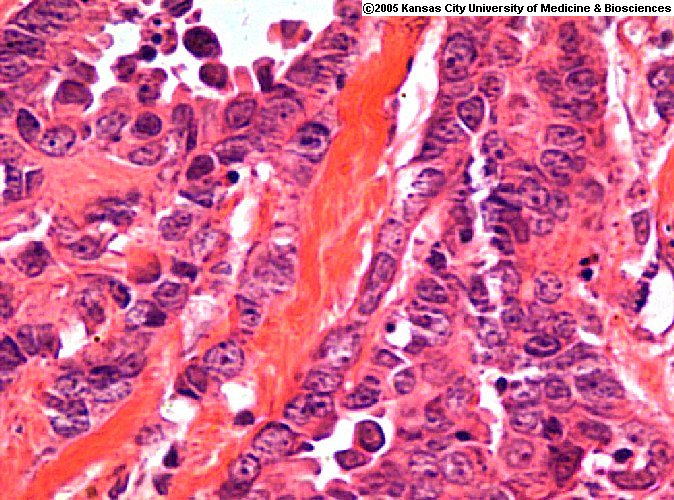
Microscopically, "scirrhous" carcinomas with cells often arranged in nests or cords or streams in a very desmoplastic stroma. Although the books tell you that single-file "Indian file" arrangement of cells is more typical of invasive lobular carcinoma, you can see it often enough in a scirrhous cancer arising from ducts. The cells usually do not look very malignant. Elastic fibers may be prominent.
MEDULLARY CARCINOMA
Big, bulky, and soft. Lymphocytes are plentiful among the tumor cells, perhaps because the cells express HLA-DR strongly (nobody knows why). The cells must be very bizarre, there must be large nucleoli, and the border is pushing. The prognosis is slightly better than that of other types. (Do you think it's all those lymphocytes fighting the cancer, or that this tumor is a distinct disease? Maybe both.)
This type of cancer is much-overrepresented among women with mutated BRCA1 syndrome (Lancet 349: 1505, 1997). Most are "triple-negatives".
MUCINOUS CARCINOMA (colloid carcinoma, gelatinous carcinoma) (Am. J. Clin. Path. 127: 124, 2007; Am. J. Surg. 196: 549, 2008).
Clumps of cells floating in lakes of mucin. Grossly, the tumor is a gelatinous mass, at least one-third composed of mucin. Relatively favorable prognosis. (* If only some areas are 33% or more mucin, call it "mixed"; otherwise call it "pure".)
* Pitfall: A "mucocele", looking perfectly benign, may be present next to an invasive mucinous carcinoma (J. Clin. Path. 61: 11, 2008). By contrast, benign mucoceles of the breast are fairly commonly found on mammography because they calcify (Am. J. Clin. Path. 138: 783, 2012).
* ADENOID CYSTIC: Very low aggressiveness in the breast (Cancer 94: 219, 2002; J. Clin. Path. 63: 220, 2010). Microglandular adenosis may be its precursor.
PAPILLARY CARCINOMA
This is the one breast cancer that we think really arises from the large ducts. Leave the distinction between benign and malignant papillary lesions to the pathologists.
{15488} carcinoma of breast, colloid type
 Mucinous / colloid cancer
WebPath Photo -- comments are down right now
TUBULAR CARCINOMA
Well-formed glands usually one cell-layer thick. Best prognosis for any breast carcinoma, very little mortality. If there are no metastases to the regional lymph nodes, a cure is near-certain. Usually luminal-A.
* Usually the tumor is star-shaped grossly. Glands may infiltrate the fat with no reaction.
METAPLASTIC CANCERS (several subtypes -- squamous, spindle-cell carcinoma, mixture with a true sarcoma, mixture with benign- or malignant-looking cartilage): Nobody really knows how this happens. Perhaps the cell of origin is myoepithelium, since they tend to light up with myoepithelial markers. All metaplastic carcinomas tend to be aggressive: J. Clin. Path. 59: 1079, 2006; Am. J. Surg. 191: 657, 2006; initial work on tumor genetics J. Clin. Path. 66: 522, 2013.
 Metaplastic breast cancer
Great photos
Pittsburgh Pathology Cases
INVASIVE LOBULAR CARCINOMA (10% of infiltrating breast cancer).
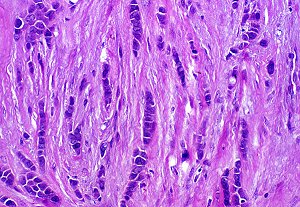
Infiltrating lobular carcinoma is famous for its cells arranged in Indian files. The cells tend to be very small and to lack much anaplasia; they look like the cells of lobular carcinoma in situ and often include signet-ring cells. Especially if you see them making circles around the ducts, the diagnosis is a cinch, but an experienced pathologist can recognize these cells anywhere.
Such tumors are often multifocal within a breast, and are often bilateral.
Lobular carcinoma is infamous for spreading to the arachnoid and to bone.
The molecular signature of lobular carcinoma (and its precursors, atypical lobular hyperplasia / neoplasia and lobular carcinoma in situ) seems to be loss of e-cadherin expression; this is now a robust finding, sensitive and specific (Am. J. Clin. Path. 125: 377, 2006 -- rarely there's some still left at the membrane). Not surprisingly, there is a germline mutation and cancer family syndrome JAMA 297: 2360, 2007. This also probably explains the classic anatomic pathologist's observation that the cells of lobular cancers and pre-cancers seem not to stick to one another.
Most are positive for estrogen and progesterone receptors and negative for ERBB2/HER2 amplification / overexpression (Am. J. Clin. Path. 136: 88, 2011).
* Future pathologists: Negative cadherin and diffuse cytoplasmic p120 are the usual defining characteristics for lobular carcinoma nowadays.
Grading's not much used for lobular carcinomas. There are subtypes that influence prognosis. You can read about them in Cancer 113: 1511, 2008. (*nbsp;Solid and pleomorphic variants are bad.)
* When a morphologic ductal and a morphologic lobular carcinoma arise in proximity in the same patient, they share mutations, i.e., both evolved from the same pre-cancer. See Am. J. Clin. Path. 132: 871, 2009. Some folks call this terminal ductule cancer, but the distinction isn't really helpful.
* All the lobular lesions of the breast: Arch. Path. Lab. Med. 133: 1116, 2009. Pleomorphic variant Arch. Path. Lab. Med. 137: 1688, 2013.
{15484} carcinoma of breast, infiltrating lobular type
{15485} carcinoma of breast, infiltrating lobular type
|
|
|
See Nature 406: 707, 2000; JAMA 295 2492, 2006; Cancer Res. 66: 4636, 2006.
The pathology team will run a series of molecular studies (Am. J. Clin. Path. 138: 770, 2012). These will be different by the time you are in practice.
When examining these patients, look for:
** bad prognosis, of course
 Inflammatory carcinoma
Trust me
WebPath Photo -- comments are down right now
A majority of breast cancers arise in the outer quadrants, particularly the upper outer quadrant, and the left breast is slightly more often affected than the right one (because it's slightly larger naturally).
We used to teach that the single most important prognostic indicator in a case of breast cancer is the size of the tumor at presentation. Now it's clear that the presence or absence of metastatic tumor in the axillary lymph nodes is even more important (Cancer 70(6S): 1755, 1992).
117: 729, 2002. You may hear the term "isolated tumor cells" (less than 0.2 mm) and "micrometastasis" (0.2 mm to 2.0 mm). Today's pathologist may also submit the tissue for molecular techniques (Br. J. Surg. 98: 4, 2011).
Today, histology competes with rapid reverse-transcription-PCR technology for mammaglobin and cytokeratin 19 mRNA on sentinel nodes: Ann. Surg. 247: 136, 2008.
The whole business about micrometastatic disease in the sentinel node has gotten strange. There's disagreement as to whether, if the cancer has spread, axillary dissection seems to help survival (Yes! J. Am. Coll. Surg. 206: 261, 2008; No! JAMA 305: 569, 2011). Another huge study found no difference in survival whether there's micrometastases in the sentinel nodes or not (JAMA 306: 385, 2011). In early cancer with the primary 1.0 cm or larger, women with without micrometastases in the marrow had 95% 5-year survival, and those with micrometastases had 90% -- so this MIGHT become part of the ordinary workup.
Other favorable prognostic factors, in addition to those already cited, include:
The age-adjusted incidence of breast cancer among US women rose by 30% during the 1980's. This is an artifact of finding them much, much earlier (Soc. Sci. Med. 46: 907, 1998).
Supposedly "the studies" mostly (not all) support breast cancer screening by mammogram as a way of cutting mortality (though the impact is not huge): Lancet 353: 1903, 1999. Most recently, screening 2500 women during their fifties will save one of them from dying of breast cancer, cause hundreds (maybe even >1000) of them to get biopsies that are perfectly benign, and (pathologists aren't perfect) causing 5-15 false-positive diagnoses with unnecessary surgery / radiation / chemotherapy (nasty reading NEJM 363: 1276, 2010). In these difficult economic times... The benefits drop to near-zero in the elderly (JAMA 282: 2156, 1999).
Prognosticating breast cancer by a 186-gene "invasiveness" profile: NEJM 356: 217, 2007. Works well for the common histopathologies. Patients with good scores had almost no deaths, and were much less likely to have metastasatic disease; and it was as powerful a predictor as initial tumor size and grade. As with profiling as a guide to typing and management, this sort of thing will probably have a major impact by the time you are in practice (the term may be "IGS" or Invasive Gene Signature).
Fine-needle aspiration is becoming very popular, and panels of molecular tests help with the prognostication (Am. J. Clin. Path. 113(5S1): S49 & S84, 2001). These include DNA ploidy, proliferation rate, HER-2/neu status (FISH, immunohistochemistry; JAMA 291: 1972, 2004; Am. J. Clin. Path. 122: 110, 2004), and p53 status.
Future pathologists: The p63 stain stains the nuclei of myoepithelium, which is very helpful (i.e., fibroadenomas will have abundant staining, most noninvasive lesions will have myoepitelium throughout, ductal carcinoma in situ will have a few myoepithelial cells but just on the edges, cancers lack myoepithelium, and only very obvious breast cancers are likely to stain with p63). Update: Am. J. Clin. Path. 128: 80, 2007.
Future clinicians: Here's a breakdown on these little (average size 16 mm) lesions, which you'll localize by needle or wire and excise (from Am. J. Surg. 164: 427, 1992, from Wash. U.; see also Br. J. Surg. 79: 1038, 1992)
80%...
benign
15%...
small invasive cancers
5%...
carcinoma in situ
NOTE: A great many genetic abnormalities have been found in breast cancer, but unlike many cancers, there is no known invariable change. No claim relating prognosis to a particular genetic lesion has stood up strikingly well, though checking for amplified c-erb-B2/HER-2/neu is now standard. Pathologists stain for the oncoprotein (Am. J. Clin. Path. 113:251 & 669 & 675, 2000; assays Arch. Path. Lab. Med. 126: 803, 2002); those with the amplification may be treated with trastuzumab ("Herceptin"), a monoclonal antibody targeting the protein. This is now mainstream and getting the protocols down now occupies the research oncologists: Lancet 375: 377, 2010.
Breast cancer
HER2 expression
Wikimedia Commons
Here's the Nottingham-Bloom-Richardson system that's becoming popular:
+1 if the nuclei are small, regular, and uniform
+2 if the nuclei are big and/or vary some in size
+3 if the nuclei vary a lot in size
+1 if there are 0-7 mitotic figures per 10 high power field
+2 if there are 8-14 mitotic figures per 10 high power field
+3 if there are 15 or more mitotic figures per 10 high power field
Scoring:
Unfavorable prognostic factors, in addition to those already cited, include:
One success story of the women's movement is the more rational, more thoughtful approach to the therapy of breast cancer. Today's woman will be given an account of the risks of various interventions, and be allowed to make her best choice. This is good. Rational management begins with rational diagnosis -- and of course, autonomy rules.
{04607} metastatic breast carcinoma in brain, scan
You learn staging (which is not a "pathology" subject -- though watch for flow cytometry of the blood to alter the current system Cancer 113: 2422, 2008) and therapies on rotations. Therapies include:
NOTE: If a woman "wants to save her breast", and chooses radiation over surgery, she's risking brachial plexus injury, with chronic severe pain and loss of the use of the arm. This was actually brought to the public's attention by a women's pressure group, and rightly so. See Br. Med. J. 308: 188, 1994.
A variety of hormonal manipulations are available. Tamoxifen, the anti-estrogen, is now standard for adjuvant therapy of hormone-sensitive post-menopausal breast cancer (Lancet 359: 2126, 2002).
The use of tamoxifen prophylaxis for women at high risk (i.e., lobular CIS, atypical hyperplasia, strong family history) is still under study, with both risks and benefits rather small (Ann. Int. Med. 137: 59, 2002). The known hazards include endometrial cancer, thromboemboli, exacerbation of endometriosis, fatty liver, and deceptive small blue "tamoxifen cells" on pap smear (Arch. Path. Lab. Med. 125: 1047, 2001).
* The anti-progesterone agent RU486 / mifepristone (once "the controversial abortion pill") has been tried and is now occasionally used in advanced breast cancer (Fert. Ster. 68: 967, 1997). Its use is still mostly in the lab. The story of the politics: JNCI 92: 1970, 2000.
The late-1990's experiments with high-dose chemotherapy plus autologous bone marrow transplantation for disseminated disease ("My HMO won't pay!") ended up showing no advantage over conventional chemotherapy (NEJM 342: 1069, 2000).
Since protocols often depend on whether there are cancer cells in the lymph nodes, pathologists now use keratin stains to show these up easily: Am. J. Surg. Path. 23: 263, 1999; Lancet 354: 896, 1999.
{24707} post-mastectomy, post-radiation with lymphedema
{12442} reconstruction after mastectomy
Clinical course: Today, one women in five will have her breast cancer recur in ten years, at least in the UK (BMJ 344: e4085, 2012). Even metastses are often indolent, and late recurrences are fairly common.
If the metastases appear in bone, survival for many years is common. Visceral metastases (lungs, liver, brain) are more ominous.
The key to surviving breast cancer is early diagnosis.
Adenoid cystic carcinoma
of the breast
Pittsburgh Illustrated Case
* Future pathologists: We have several stains that may be of help in distinguishing identifying a metastasis as being of breast origin, a relatively common situation. Updates Am. J. Clin. Path. 127: 103, 2007; Arch. Path. Lab. Med. 132: 239, 2008.
DISEASES OF THE MALE BREAST
GYNECOMASTIA
Proliferation of a man's ducts (usually mild) and later stroma, perhaps with edema and maybe some fat, unilateral or bilateral. Real gynecomastia usually feels firm and rubbery.
It can be idiopathic (adolescents or older men), due to hypoandrogenism (remember XXY), or due to hyperestrinism (tumors, iatrogenic, female impersonators, testicular tumors -- did you check? -- and of course guys using anabolic steroids to look more masculine, heh heh).
A teenaged boy who's troubled by it -- and it can be VERY upsetting -- deserves to be treated with tamoxifen or surgery.
For decades I've been mystified by bath oils and soaps containing weird herbal concoctions, and the men who use them. Lavender and tea-tree oils have estrogen-like activity and seem to cause gynecomastia (NEJM 356: 479, 2007). Stay tuned for more unpleasant surprises.
Other drugs to remember are digitalis and spironolactone; soy products contain natural estrogens.
Idiopathic gynecomastia puts a plain-vanilla man at no greater risk for cancer, but note that XXY's and female impersonators on estrogens are at increased risk.
The severity is widely variable. A man can be cured by office surgery, if he wishes.
* There are of course ducts but no lobules. The duct epithelium always has exactly three layers made of three different cell types (Am. J. Surg. Path. 36: 762, 2012).
"Pseudogynecomastia" is seen on obese men; unlike in true gynecomastia, there is no hard nubbin under the nipple.
{49363} gynecomastia
{12512} gynecomastia, histology
{49434} gynecomastia, 5 year old male, some kind of hormonal problem
 Gynecomastia
WebPath Photo -- comments are down right now
CARCINOMA OF THE MALE BREAST
Uncommon (100x less common than in women, 20x-50x more common in XXY's than among other men, and much more common in BRCA2 families -- 7% of the men carrying the gene will get it by age 80; BRCA1 carries much less risk). Once under-recognized and hence very lethal, the majority of men today get cures.
It is almost always an infiltrating ductal carcinoma, usually without much desmoplasia.
{24603} carcinoma of breast, man
OTHER CANCERS
These can look totally benign clinically and microscopically, and then metastasize. Many pathologists will tell you that all hemangiomas of the breast should be considered malignant unless they are obviously very sharply circumscribed, thoroughly benign-looking, and completely away from the lobules.
THE BREAST IMPLANT FIASCO: The U.S. public pays for willful ignorance of the fundamental methods of science and rational decision-making, with ordinary decent women, as usual, the big losers (NEJM 326: 1696, 1992; NEJM 342: 781, 2000).
 Silicone implant
WebPath Photo -- comments are down right now
 Silicone implant
In place
WebPath Photo -- comments are down right now
 Silicone leak
Granulomas
WebPath Photo -- comments are down right now
* In April 1992, the FDA banned the use of silicone breast implants except in studies, even for women
with mastectomies (NEJM 326: 1713, 1992). In previous years, about 120,000 women per year got
breast implants for breast augmentation (i.e., "to look better"), and 30,000 got the implants for
reconstruction after mastectomy.
* The "scientific rationale" was slim but not altogether lacking. We do know that silicone slowly
leaks out through the capsule of the implant. There was a series of four women with implants who
then got scleroderma (Ann. Int. Med. 111: 377, 1989). One other patient with a ruptured implant
got "scleroderma" and it resolved (!) when the implant was removed (Arch. Derm. 126: 1198, 1990).
Somebody was impressed enough to coin the term "human adjuvant disease", conjecturing that the gel was causing
people to get sensitized to their own proteins, and the rest is history.
* Shortly after the ban, a California study found anti-nuclear antibodies in 11 women with implants plus
scleroderma (most common), lupus, or some overlap syndrome; there was no typical serologic
picture, but the study related disease onset to traumatic rupture of the implants (Lancet 340: 1304,
1992). The most interesting work I've seen so far was 3 cases from South Carolina, in which silicone
was demonstrated at sites of connective tissue disease, and the illness remitted after removal of the
implants (Arch. Derm. 129: 63, 1993). A Danish mega-review found only 32 cases of all
connective tissue disease, mostly scleroderma (Kjoller et. al., 93134723, abstract), "much less than
you'd expect by chance" (gee whiz), but was impressed by anecdotes of disease clearing on removal of the
implants. A big review found no increase in connective tissue disease in implant recipients: NEJM
332: 1666, 1995; the only recent "study" that found a link took women's self-reports and made no
attempt to confirm them (i.e., if an implant recipient said she had lupus, then she had lupus).
Updates: NEJM 334: 1505 & 1513, 1996; Neurology 46: 308, 1996 ("neuromythology
of silicone breast implants"); Plast. Recon. Surg.
99: 1362, 1997; Br. Med. J. 316: 147, 1998 seems to have finished
the "connective tissue disease" claim off. Most recently, there was an essentially
negative study in Am. J. Epidem. 160: 691, 2004.
"Antipolymer antibody"'s existence remains
unsubstantiated by the general scientific community.
The link with fibromyalgia (which is a real disease / syndrome but one that a pathologist cannot
exhibit) remains a public concern and I think with some reason.
The FDA did a survey of recipients' health
and x-rayed to see if the silicone had leaked. When the obvious confounders
were controlled for, everything pretty much disappeared except for a link
between implant rupture and "fibromyalgia".
Nobody's reproduced this surprising finding yet,
previous studies were negative (J. Rheum. 27: 2237, 2000)
or extremely weak (the Wichita group suggested that psychological
factors contribute both to fibromyalgia and to getting implants),
and the folks in Denmark found that
whether or not the implants have ruptured seems to have no effect
on how Danish women say they feel (Plast. Rec. Surg. 111: 723, 2003).
A huge meta-analysis found nothing except people misinterpreting
foreign-body reactions as evidence of systemic disease, and examining flaws in the
previous work: Plast. Rec. Surg. 120:
625, 2007. Flow cytometry and sub-subclassification of circulating lymphocytes
shows no differences ("no pro-inflammatory effect") in implant patients
(Plast. Rec. Surg. 121: 25, 2008).
* Under a 1976 law, manufacturers had to prove their devices were "safe and effective". Of course,
that doesn't mean risk-free. The FDA merely had to decide that the benefits outweighed any
demonstrated risks. Unfortunately, because the benefits of breast augmentation are subjective, the
FDA acted as if there were no benefits (NEJM 326: 1695, 1992). Internal memos from
manufacturers of the implants painted a less-than-edifying portrait of corporate America.
"Consumer advocates" who have always tolerated alcohol and tobacco (including all those tobacco
advertisements directed at young girls)
presented anecdotes and scare-stories designed to terrify the two-million-plus women with implants.
Militant feminists were divided between "a woman's right to make decisions about her own body"
and the need to oppose the "sexist" pressures that makes some women feel they needed breast
augmentation in the first place. (It seems to your lecturer that a reasonable person can say
"no" to the
latter while still supporting the former.) The result was a media circus that led to the ban, as well
as around $4 billion dollars in liability payments; the whole thing may end up costing $40-$60
billion (Science 276: 1564, 1997). See also Cleveland Clinic J. Med. 59: 539, 1992; Plast. Rec.
Surg. 90: 1102, 1992; CMAJ 147: 772, 1127 & 1141, 1992; Arthr. Rheum. 39: 1615, 1996. It
was ironic, in mid-1994 in the wake of the (expected) studies showing no serious risk (NEJM
330: 1697, 1994 was best-known), to hear the same investigative
journalists turn wildly indignant against the
FDA's ban ("Government interference in our private lives!")
A psychologist explains how this sort of thing contributes to public
ill-health by making people somatize: Ann. Rheum. Dis. 60: 653, 2001.
We need a word to go with "iatrogenic disease" to describe people
who develop real (though subjective) symptoms because of pop claims
about things that are probably harmless
(other people's perfume, other people eating
peanuts on the airplane, etc.) The FDA decided in late 2003
not to allow the devices to be reintroduced, then reversed itself
in late 2006, and fourteen years after their withdrawal, they
are available again (Br. Med. J. 333: 1139, 2006). I've given up trying to make sense of this.
KNOW: In late 2008, a Dutch group reported a tiny-sample association between the very-rate ALK-negative anaplastic large T-cell lymphoma and implants (JAMA 300: 2030, 2008). Cases of lymphoma in the implant capsule pop up from time to time, though they are thankfully still very rare; they are generally of the anaplastic large T-cell type (Plast. Recon. Surg. 126: 39e, 2010; Cancer 117: 1478, 2011; Plast. Recon. Surg. 127: 2141, 2011; Plast. Recon. Surg. 128: 629 & 112e, 2011). You'll need to warn patients of this very rare risk, which is probably real.
By the way: "Women who undergo breast augmentation with silicone implants have a lower risk of breast cancer than the general population. This finding suggests that these women are drawn from a population already at low risk and that the implants do not substantially increase the risk (NEJM 326: 1649, 1992)". Well, looking at the statistics again, there probably isn't any real effect one way or the other (NEJM 332: 1535, 1995; Plast. Rec. Surg. 120(S1): 70-S, 2008). For some reason that I cannot explain, nobody seems to have looked at bust size as a natural risk factor for breast cancer.
 | * In Isaac Bashevis Singer's famous short story Gimpel the Fool, one of the characters dies of cancer of the breast. The story deals with a simple baker's struggle to be a good person in a world full of deceit. Highly recommended. |
BIBLIOGRAPHY / FURTHER READING
I urge anyone interested in learning more about breast pathology to consult these standard textbooks.
In my notes, the most helpful current journal references are embedded in the text. Students using these during lecture strongly prefer this. And because the site is constantly being updated, numbered endnotes would be unmanageable. What's available online, and for whom, is always changing. Most public libraries will be happy to help you get an article that you need. Good luck on your own searches, and again, if there is any way in which I can help you, please contact me at scalpel_blade@yahoo.com. No texting or chat messages, please. Ordinary e-mails are welcome. Health and friendship!
*SLICE OF LIFE REVIEW
{11770} breast, normal
{14992} mammary gland (prepubertal), normal
{14992} mammary gland (prepubertal), normal
{14993} mammary gland (prepubertal), normal
{14993} mammary gland (prepubertal), normal
{14994} mammary gland (secreting), normal
{14994} mammary gland (secreting), normal
{14995} mammary gland (secreting), normal
{14995} mammary gland (secreting), normal
{14996} mammary gland (ct stain), normal
{14996} mammary gland (ct stain), normal
{14997} mammary alveolus (active), normal
{14997} mammary alveolus (active), normal
{14998} mammary ducts (mature), normal
{14998} mammary ducts (mature), normal
{14999} mammary ducts (mature), normal
{14999} mammary ducts (mature), normal
{17489} breast, normal
{20293} breast, normal
{20690} mammary gland, normal
{20690} mammary gland, normal
{20691} mammary gland, gland epithelium
{20693} mammary gland, gland epithelium
{20694} mammary gland, gland epithelium
{20793} mammary gland
{20794} mammary gland
{20968} mammary gland
{20969} mammary gland, alveolus
{50571} breast, normal duct
{50572} breast, normal duct

| New visitors to www.pathguy.com reset Jan. 30, 2005: |
Ed says, "This world would be a sorry place if people like me who call ourselves Christians didn't try to act as good as other good people ." Prayer Request


| If you have a Second Life account, please visit my teammates and me at the Medical Examiner's office. |
Teaching Pathology
 Ed's Pathology Review for USMLE I


 | Pathological Chess |
 |
Taser Video 83.4 MB 7:26 min |
 |
Click here to
see the author prove you can have fun skydiving without being world-class. Click here to see the author's friend, Dr. Ken Savage, do it right. |


 Breast / Heme (?!)
 Breast
 Normal breast
 Normal breast
 Fibrocystic change
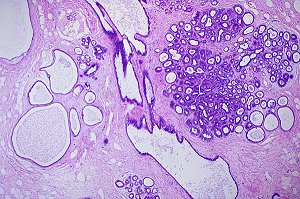 Fibrocystic change of breast
 Breast cyst
 Fibrocystic change
 Fibrocystic change
 Sclerosing adenosis
 Hyperplasia
 Hyperplasia
 Atypical hyperplasia
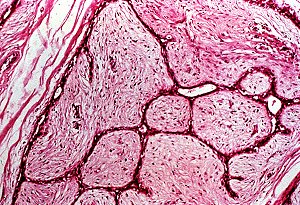 Fibroadenoma
 Fibroadenoma
 Fibroadenoma
 Breast Cancer
 Lobular carcinoma
 Cribriform cancer
 Comedocarcinoma
 Comedocarcinoma
 Breast cancer
 Fine needle aspiration
 Scirrhous cancer
 Breast cancer
 infiltrating breast cancer
 Breast cancer
 Scirrhous cancer
 Scirrhous cancer
 Scirrhous cancer
 Breast cancer
 Scirrhous cancer
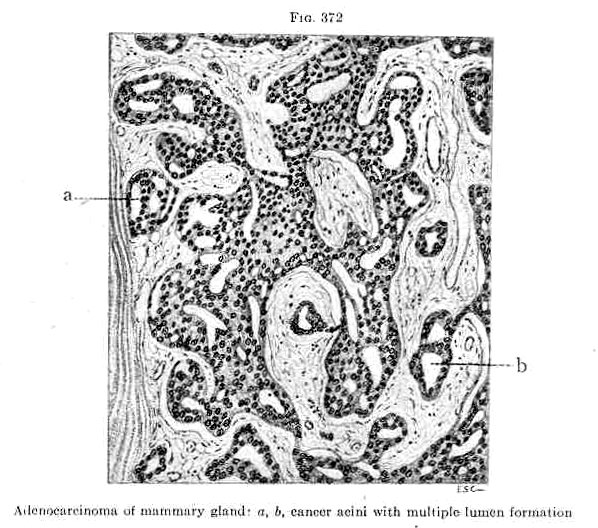 Cribriform breast adenocarcinoma
 Indian Files
 Breast cancer
 Infiltrating lobular carcinoma
 Lobular carcinoma